You choose silicone hoses over rubber for extreme heat, high pressure, and peak performance. Before ordering, you likely have a silicone hose FAQ in mind. Sunrise gathered the 50 Questions buyers ask most from real customer talks. These clear answers help you decide with confidence.
Key Takeaways
-
Silicone hoses handle extreme temperatures and pressures better than rubber, but they fail with fuel or oil unless you add a special liner.
-
You can customize silicone hoses in size, color, and reinforcement to fit your exact needs and boost performance.
-
Proper installation and maintenance prevent leaks and make your silicone hoses last longer.
Top 50 Questions on Material Properties

Silicone vs. Rubber
You pick silicone for one main reason: it handles extreme conditions that rubber cannot survive. Standard silicone works from -60°C to 200°C. EPDM rubber, by contrast, handles -40°C to 100–120°C in conventional grades. Advanced EPDM formulations reach 150°C continuous and 175°C short-term, yet silicone still wins for continuous exposure above 120°C. Silicone also stays flexible down to -60°C, while EPDM becomes rigid at approximately -10°F (-23°C) and below.
Does your average daily driver need silicone? Not always. If your engine runs at normal temperatures and pressures, rubber serves you fine at a lower cost. Silicone shines in turbochargers, charge air systems, and racing applications. These setups demand high temperature, pressure pulsation, oil mist exposure, and vibration resistance. Those extreme demands cause premature failures in ordinary rubber hoses.
Silicone has two weaknesses you should know. First, standard silicone is not resistant to non-polar organic compounds such as gasoline, diesel fuel, and petroleum-based oils. These substances cause the silicone to swell, soften, degrade, and ultimately lose all mechanical properties. Second, silicone has higher permeability than rubber. Fuel and vapor molecules pass through silicone more easily. A fluorosilicone liner solves the fuel contact problem, but you must specify it when ordering.
A reputable OEM hose supplier like Sunrise reduces your risk of cracking or bursting. Material quality directly affects cracking resistance. Lower-cost compounds with less anti-ozonant and antioxidant protection age faster even when pressure ratings appear equal. When you compare silicone hose manufacturer questions across suppliers, ask about compound formulation and reinforcement type. Fiberglass reinforcement withstands temperatures up to 260°C but is inherently brittle and prone to fatigue failure under high-frequency engine vibration. Aramid fiber, being a polymer, offers superior flexibility and fatigue resistance.
Durability and Lifespan
How long does a silicone hose last? Several factors determine lifespan. Thermal-oxidative aging accelerates roughly two times for every 10°C above the rated temperature. Ozone attack creates fine perpendicular surface cracks over months to years. UV degradation causes surface chalking and shallow crack networks after one to three seasons of direct exposure. Plasticizer migration leads to stiffness and gradual loss of flexibility.
Cracking and surface degradation stem from thermal aging and excessive temperature cycling. Delamination occurs when bonding between silicone layers or between silicone and reinforcement weakens. Heat, pressure, and long-term aging drive this separation. A twisted hose during installation can reduce service life by more than 70%. Excessive bending radius causes reinforcement deformation and localized stress concentration.
You control most lifespan factors through proper selection and installation. Stay within the rated temperature range. Route hoses away from sharp edges. Avoid constant tension and vibration. Choose the right reinforcement for your application. These steps maximize the service life of any quality silicone hose.
Design and Customization
Size, Color, and Shape
You can specify almost every dimension of a silicone hose. Inner diameter, outer diameter, and wall thickness all accept custom values. Standard automotive sizes cover inside diameters from 1/4 inch to 1 inch. Bend radii range from 0.4 inch to 4.0 inches. The chart below compares these measurements across common part numbers.
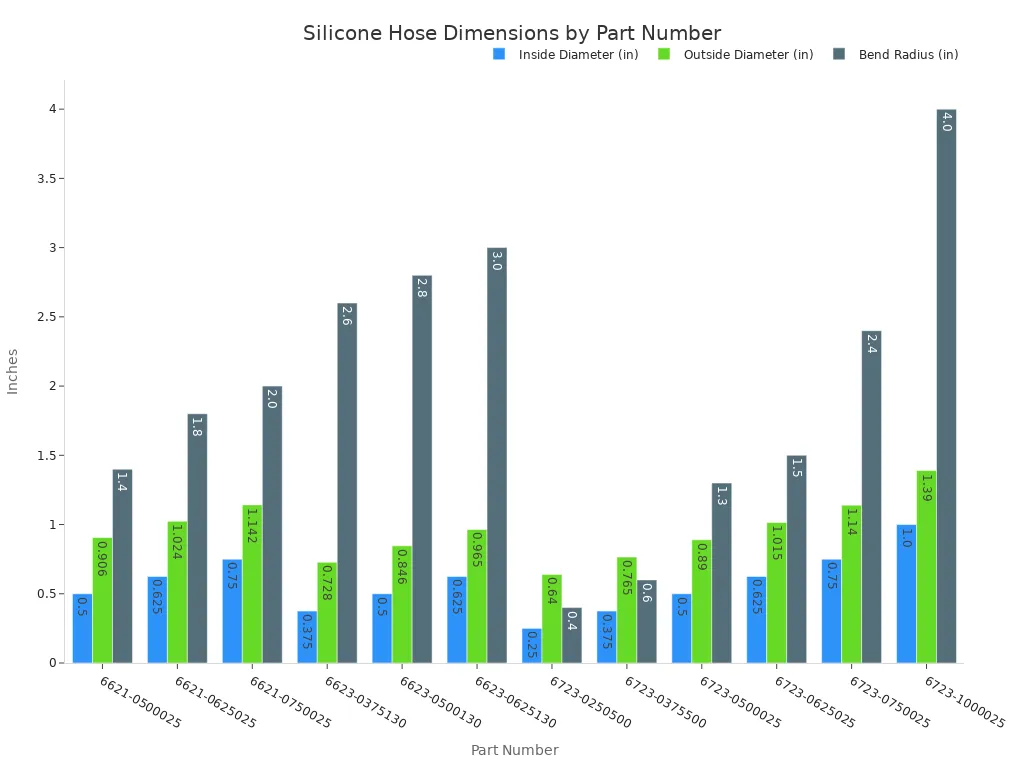
You specify both inside and outside diameters and wall thickness for reducers and hump hoses. That level of control lets you match existing pipework exactly. Color options extend well beyond standard black. Sunrise offers Pantone color matching, double-color, multi-color, gradient, and marble effects. Custom printing adds logos or patterns through silk screen, pad, heat transfer, water transfer, or digital methods.
|
Customization Area |
Available Options |
|---|---|
|
Inner diameter |
Custom |
|
Outer diameter |
Custom |
|
Wall thickness |
Custom |
|
Color |
Pantone match, multi-color, gradient, marble |
|
Printed branding |
Silk screen, pad, heat transfer, water transfer, digital |
OEM hose supplier capabilities mean you can order hoses with your part number or company logo printed directly on the cover.
Reinforcements and Coatings
Reinforcement layers determine pressure and pulsation limits. Aramid fiber provides flexibility and fatigue resistance for high-frequency vibration. Fiberglass withstands higher temperatures but resists bending fatigue less well. Multi-ply reinforcement adds strength for turbocharger and charge air systems.
Coatings extend compatibility. A fluorosilicone liner protects against fuels and petroleum-based oils. These substances degrade standard silicone. Special covers resist abrasion, oil mist, or ozone. Sunrise tailors reinforcement and coating to your specific fluid, temperature, and pressure conditions.
Custom silicone hoses are tailored to exact specifications, including specific bend radius, unique diameter, or multi-ply reinforcement. They are available in a variety of vibrant colors, allowing color-matching to a vehicle's livery or branding.
Compatibility and Performance
Fluids and Temperature Limits
You must match your hose material to the fluid it carries. Standard silicone handles water, coolant, air, and oil mist well. It does not resist gasoline, diesel fuel, or petroleum-based oils. These non-polar compounds cause silicone to swell, soften, and lose mechanical strength. A fluorosilicone liner solves this problem for fuel contact. You must specify that liner when you order. Medical and industrial tubing adds another layer of concern. You need biocompatible compounds for medical use and clean-room compatible materials for semiconductor or food processing lines. Always confirm chemical compatibility before you commit to a large order.
Temperature limits depend on the compound and reinforcement. Standard silicone works from -60°C to 200°C. Fiberglass reinforcement pushes the upper limit to 260°C. Aramid fiber trades some heat resistance for better vibration fatigue resistance. You should diagnose your current hoses before choosing replacements. Look for cracks, stiffness, swelling, or delamination. Each symptom points to a different failure mode. Cracks suggest thermal aging. Swelling points to chemical attack. Stiffness indicates plasticizer loss. Match the replacement hose to the specific part of the system. Turbocharger connections need high-temperature aramid reinforcement. Coolant lines can use standard silicone. Fuel lines require a fluorosilicone liner.
Fit and Sizing
A leak-free fit starts with accurate measurement. Follow these steps:
-
Match the hose inner diameter (ID) to the barb outer diameter (OD).
-
Measure both the barb OD and the hose ID with calipers.
-
The hose should slide onto the barb with moderate resistance, not require excessive force.
The barb outer diameter must correlate to the tube inner diameter. Tubing and hose materials vary, so the accuracy of the tube ID, the tube flexibility, and the application are critical when selecting a fitting. For tighter seals without a retention device, you may need to increase the barb OD. Too large an OD makes installation difficult. A mismatch between barb design and tubing durometer can reduce pull-off and blow-off resistance and increase the chance of leaks. These are among the most common 50 Questions buyers raise, and for good reason. A poor fit ruins performance no matter how good the hose material is.
Pricing and Ordering
Cost Factors and Bulk Orders
Raw silicone compound drives most of your hose cost, at 45–55% of the total price. Labor and line time add 15–20%. Tooling amortization for standard sizes runs 5–10%, and quality testing and certification overhead adds another 5–10%. Packaging, logistics prep, and margin make up the rest.
Order volume changes your per-meter rate. Runs under 500m carry the highest rate because setup cost spreads across a small batch. Orders of 1,000–5,000m typically land 5–10% below that baseline. Runs above 5,000m reach 10–20% below baseline. Custom coloring needs a dedicated compound batch, so it adds cost at any volume. Braided reinforcement carries a 30–60% per-meter premium over single-wall tubing. For reference, 1-inch EPDM averages $2.15 per foot, while silicone averages $5.70.
Minimum order quantities vary by product. Hoses require 500m for mass production, and sealing strips require 1,000m. Sample orders below MOQ stay negotiable for first-time cooperation. Braided hoses ship in 3–7 days, and bulk orders ship in 7–30 days after advance payment.
Warranty and Returns
Warranty terms differ sharply between suppliers, so ask your silicone hose manufacturer questions before you commit. Some manufacturers offer a lifetime warranty on every silicone hose. Others guarantee products against defects in material and manufacture at purchase time, with replacement or refund as the exclusive remedy. Watch for void conditions. One manufacturer voids coverage if you use unapproved hose clamps.
Return policies also vary. Some suppliers treat all web sales as final, with no exchanges for misordered colors or sizes. Others accept returns with original paperwork and no authorization number. Freight damage needs immediate email contact, not a return shipment.
Certification protects you here. Look for ISO 9001:2015, IATF 16949:2016, FDA 21 CFR 177.2600, and USP Class VI documentation. Verify certificates on the issuing body's website. A reliable OEM hose supplier provides batch-specific test reports with ISO 17025 lab accreditation.
Installation and Maintenance
Installation Best Practices
Proper installation prevents most fitting failures. Start by choosing the right clamp for your connection. The table below summarizes recommended clamp types and torque ranges.
|
Clamp Type |
Torque |
Application |
|---|---|---|
|
Worm-gear |
10-30 in-lb |
General coolant |
|
Solid-band |
30-50 in-lb |
Soft hose, thermal cycling |
|
T-bolt |
60+ in-lb |
High-pressure silicone |
Apply 20-30 in-lb. Retorque after heat soak. Position the clamp about 1/4 inch from the hose end. Avoid oversized clamps with long sharp tails; bend the tail down or use a silicone clamp finisher.
Use standard or spring-loaded T-bolt clamps for turbo hoses. Install the band behind the pipe bead, not over it. Tighten per manufacturer instructions; over-tightening causes blow-off under boost.
Common mistakes in any silicone hose FAQ:
-
Overtightening cuts grooves that leak under pressure.
-
Sharp worm-gear clamps cut silicone; use lined bands or T-bolts.
-
Smooth pipe nipples cannot create reliable seals.
-
Skipping re-torque after heat cycling causes loose connections.
Maintenance and Storage
Inspect your hoses every six months. Look for cracks near the ends, bulges, soft spots, swelling, or chafing. Replace hoses every 5-7 years if your vehicle experiences regular heat cycles, regardless of mileage.
The table below lists recommended storage conditions.
|
Parameter |
Recommended Condition |
|---|---|
|
Temperature |
60–80°F optimum; max 100°F (38°C) |
|
Humidity |
Below 75%; seal in moisture-proof bags |
|
Light |
No direct sunlight |
|
Ozone |
Avoid ozone equipment |
|
Shelf life |
15–20 years (dry, dark) |
Keep hoses in sealed plastic bags in a dark, cool drawer. Avoid hot attics, furnaces, and UV exposure. These conditions cut shelf life by 30-50%.
Silicone hose manufacturer questions about your installation? Sunrise's team provides after-sales support. An OEM hose supplier like Sunrise offers guidance on clamp selection and routing. Asking the right questions saves you time and money.
Silicone hoses deliver superior durability, customization, and compatibility. Confirm material specs, fit, and pricing before ordering. Match each hose to your application's specific fluids, temperatures, and pressures. Asking the right 50 Questions saves time and money. Sunrise provides personalized answers and stands ready with quotes or samples. Use this guide as your checklist before placing your next order.
FAQ
What temperature range do standard silicone hoses handle?
Standard silicone works from -60°C to 200°C. Fiberglass reinforcement raises the upper limit to 260°C. Aramid fiber trades some heat resistance for better vibration fatigue resistance.
Can silicone hoses carry fuel or gasoline?
No. Standard silicone swells and degrades with gasoline, diesel, and petroleum-based oils. You need a fluorosilicone liner for fuel contact. Specify this liner when you order.
How do I know which clamp to use?
Match the clamp to your application. Worm-gear clamps suit general coolant lines. T-bolt clamps handle high-pressure silicone. Apply 20-30 in-lb and retorque after heat soak.
These answers cover the most common 50 Questions buyers raise. Your specific application may need different specifications. Always confirm details with your supplier before ordering.